

Commerce Peaks Demand Platforms That Don’t Break
How BigCommerce Delivers Performance at Scale
BigCommerce is built to handle traffic spikes, global demand, and high transaction volumes by managing infrastructure, performance optimization, and uptime—ensuring reliability during critical sales moments.
BigCommerce Performance Questions CTOs Ask:
Can BigCommerce handle high-traffic stores?
Yes. BigCommerce is designed to handle high traffic and large transaction volumes through its SaaS infrastructure, global CDN, and auto-scaling capabilities—without requiring merchant-managed servers.
How does BigCommerce perform during peak sales?
BigCommerce performs reliably during peak sales by automatically scaling resources and maintaining consistent uptime, even during flash sales and seasonal traffic surges.
Is BigCommerce suitable for enterprise commerce?
Yes. BigCommerce is used by enterprise brands that require scalability, security, and global reach without the operational burden of self-hosted platforms.
What are BigCommerce’s scalability limits?
For most businesses, scalability limits are rarely reached. Constraints typically relate to business logic complexity rather than traffic or infrastructure capacity.
Modern Commerce Demands Decoupled Architecture
Why BigCommerce Excels at Headless and API-First Commerce
BigCommerce supports headless architectures through robust APIs, enabling businesses to build custom storefronts while relying on a stable, managed commerce backend.
How CTOs Build Flexible Architectures with BigCommerce:
Is BigCommerce API-first?
Yes. BigCommerce offers comprehensive APIs that allow full control over frontend experiences while maintaining core commerce functionality.
Can BigCommerce support headless storefronts?
Absolutely. BigCommerce is widely used in headless setups, integrating with modern frontend frameworks and CMS platforms.
How flexible is BigCommerce for custom UX?
BigCommerce enables complete frontend customization without compromising backend stability, making it ideal for brands focused on unique user experiences.
How does BigCommerce integrate with CMS and ERP systems?
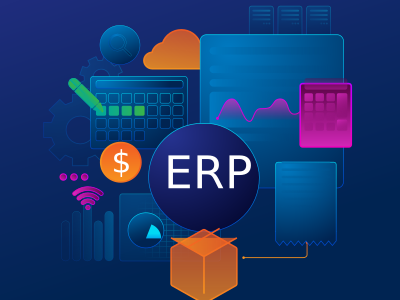
BigCommerce integrates seamlessly with CMS, ERP, PIM, and CRM systems through APIs and native connectors.
Trust Is Built Into the Platform
How BigCommerce Secures Commerce Operations
BigCommerce delivers enterprise-grade security, compliance, and uptime by managing infrastructure, updates, and monitoring—reducing operational risk for merchants.
BigCommerce Security Questions CTOs Care About:
Is BigCommerce secure for online transactions?
Yes. BigCommerce is PCI DSS compliant by default, handling secure payments and sensitive data without merchant-managed security infrastructure.
How does BigCommerce handle compliance?
BigCommerce supports compliance through built-in security standards, regular audits, and adherence to global regulations.
How is customer data protected?
Customer data is protected through encryption, access controls, and secure cloud infrastructure managed by BigCommerce.
What reliability guarantees does BigCommerce provide?
BigCommerce offers strong uptime SLAs, monitoring, and redundancy to ensure consistent platform availability.
Speed at Scale Comes from Removing Infrastructure Friction
How BigCommerce Enables Teams to Build Faster Without Operational Drag
BigCommerce removes infrastructure and maintenance overhead, allowing development teams to focus on experience, integrations, and growth. Its API-first model supports modern workflows and collaboration across distributed teams.
Why BigCommerce Improves Velocity as Teams Grow:
Does BigCommerce accelerate development?
Yes. BigCommerce accelerates development by eliminating the need to manage hosting, scaling, and security. Teams can focus entirely on frontend experience, integrations, and business logic instead of operational concerns.
Is BigCommerce maintainable across teams?
Yes. BigCommerce is highly maintainable across teams because core platform updates, security patches, and infrastructure are managed centrally, reducing coordination overhead and minimizing technical debt across large teams.
How does BigCommerce support modern workflows?
BigCommerce supports modern workflows through APIs, headless architectures, CI/CD-friendly integrations, and compatibility with modern frontend frameworks—enabling agile, decoupled development practices.
Why do enterprises adopt BigCommerce?
Enterprises adopt BigCommerce to gain scalability and security without managing infrastructure. It allows large teams to move faster, reduce operational risk, and focus on innovation rather than platform maintenance.
Operational Simplicity Is a Long-Term Advantage
Why BigCommerce Delivers ROI Beyond Initial Launch
BigCommerce is chosen for long-term value because it reduces operational costs, minimizes platform risk, and scales seamlessly allowing businesses to grow without repeated replatforming or infrastructure reinvestment.
Why Brands Commit to BigCommerce Long Term:
Is BigCommerce a long-term platform?
Yes. BigCommerce is a stable, continuously evolving SaaS platform designed for long-term commerce operations, offering predictable updates, enterprise support, and ongoing innovation without disruptive migrations.
How does BigCommerce reduce operational costs?
BigCommerce reduces operational costs by handling hosting, scaling, security, and updates eliminating the need for dedicated infrastructure teams and lowering total cost of ownership over time.
Can BigCommerce grow with business expansion?
Absolutely. BigCommerce scales globally across traffic, regions, channels, and integrations supporting business expansion without requiring platform changes or major architectural overhauls.
Why do brands migrate to BigCommerce?
Brands migrate to BigCommerce to escape infrastructure complexity, reduce maintenance burden, and gain a scalable, API-first platform that supports growth without sacrificing stability or performance.